Debates over the possibilities of AI have been raging since the 1770s. An inventor by the name of Wolfgang von Kempelen debuted his creation in Vienna: A chess-playing automaton known as the Turk consisted of a mechanical man dressed in robes and a turban who sat at a wooden cabinet that was overlaid with a chessboard. The Turk was designed to play chess against any opponent, but the Turk became popular recently when Andranik Matikozyan, Grand Chessmaster, and a three-time southern California chess champion played and got checkmated by the Turk.

Back in those days, the focus was developing mechanical marvels aka Automatons that simulated the actions of living beings such as writing programmable text, playing music, etc.
Artificial Intelligence
Fast forwarding to now, an emerging trend called Artificial Intelligence (AI) aka Cognitive Computing promises to give rise to computers or machines that sense, perceive, learn from, and respond to their environment and their users.
AI is enabling the emergence of new product categories, reshaping how businesses engage with customers (B2C), engage with their employees (B2E) and transforming how work gets done across industries.
In recent years, tech companies have used man-versus-machine competitions to show they are making progress on A.I. In 1997, an IBM computer beat the chess champion Garry Kasparov. Five years ago, IBM’s Watson system won a three-day match on the television trivia show “Jeopardy!” Now, Google’s A.I. program is drawing attention when one of its software defeated one of the world’s top players of Go, one of the most complex board games ever created, in a best-of-five series of matches.
IDC estimates that by 2020, the market for artificial intelligence or cognitive applications will reach $40 billion. And 60 percent of those applications, the firm predicts, will run on the platform software of four companies — Amazon, Google, IBM, and Microsoft.
In less than 10 years, Artificial Intelligence will be to computing what transaction processing is today. Computers will communicate with us on our terms, rather than us having to interpret and adapt to them. – Rob High, CTO, IBM Watson
On-Demand AI Services
As AI starts to hit the mainstream via API services such as speech and image recognition, tone and emotion analysis, language translation and dialog capabilities, the idea of humans and computers working together is a theme that many companies are starting to explore.
IBM has released a set of Cognitive API services in the Watson Developer Cloud that clients can leverage to incorporate cognitive capabilities in both front-office and back-office business processes.
1. Personality Insights service, which measures personality traits by using linguistic analytics to extract a spectrum of cognitive and social characteristics from the text data that a person generates through blogs, tweets, forum posts, and more.
2. Tone analyzer: This API can measure similar emotions in samples of text from a sentence to a single word. For e.g. A dating site profile that contained the sentence, “I raised two kids and now I’m starting a new chapter in my life.” Based on psycholinguistics and emotion and language analysis, tone analyzer API could determine that about a quarter of people reading that would detect anger, suggesting it might be advisable to change the wording.
3. Emotion analysis: This API service uses linguistic analytics to gauge emotions implied by a sample of text, returning confidence scores for anger, disgust, fear, joy, and sadness. For instance, a customer review site such as Yelp could measure the level of disgust in a restaurant review site to help the business understand how it needs to improve.
4. Personality insights: This API service can extract insights from a lengthy piece of text by a particular person, providing measurements of characteristics such as introversion or extroversion and conscientiousness. It could be used, for instance, to help recruiters match candidates to compatible companies.
AI and Robots
Everywhere we go there will be a presence of cognitive computing in some form that facilitates our life. AI technology allows systems to understand the world in the way that humans do, through senses, learning, and experience. This kind of understanding of human emotions and personality may find its most potent application in robots.
IBM is working with Softbank’s Aldebaran NAO robots to give them more human-seeming characteristics, such as the ability to converse more naturally, gesture to punctuate key points–even sing a Taylor Swift song.
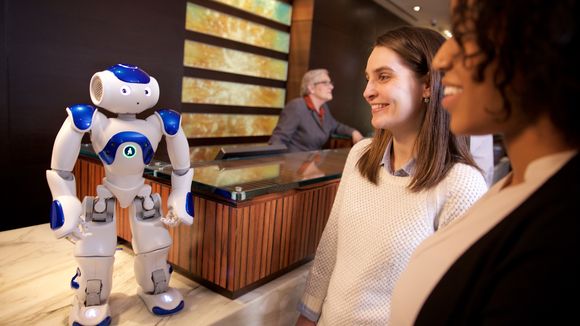
Connie (pictured above), a Watson-enabled robot concierge, has made its debut at the Hilton McLean. IBM has developed the robot, which draws on domain knowledge from Watson and WayBlazer to help hotel guests figure out what to visit, where to dine, and how to find anything at the property. Other hotel companies have experimented with robot technology as well. Starwood Hotels and Resorts has a Botlr, which can deliver room service. And the Yotel in New York has a luggage-toting robot.
In fact, despite the assumption by many that robots will be mainly used for taking care of rote tasks, they may be more important for communications between people and computer systems or cloud applications. This leads to the development of AI messaging interfaces called “chatbots” on connected devices.
Chatbots
Messaging “chatbots” are basically software that can conduct a human-like conversation and do simple jobs once reserved for people. Facebook has started to introduce chatbots on the messenger platform that allows us to chat and transact business with 1-800-Flowers and a few other vendors. At the recently concluded F8 conference, Facebook revealed how they are planning to expand the list of chatbots with AI. WeChat provides similar services in China to pay for meals, order movie tickets and even send each other gifts. In the near future, users of Microsoft’s Skype and Canada’s Kik can expect to find newly automated assistants powered by AI offering information and services at a variety of businesses.
Messaging bots can handle a wider range of tasks including mobile maintenance crew, mobile inspection, processing warranty claims, and providing concierge services across a variety of consumer businesses. In part, that’s because bots can recognize a variety of spoken or typed phrases, where apps force users to choose from options on a drop-down menu. Reaching a chatbot can be as simple as clicking a link in an online ad or scanning a QR code with a smartphone camera.
As the big messaging players open up their technology to bots, businesses and brands will need a bot presence to fill this communication with their customer base. I believe this will lead to an overhaul of internal data and business processes in order to provide on-demand services to customers, employees, and others on any connected devices.
Impact of AI is growing
In The Second Machine Age MIT’s Erik Brynjolfsson and Andrew McAfee reveal the forces driving the reinvention of our lives and our economy. As the full impact of digital and cognitive technologies is felt, we will realize immense bounty in the form of dazzling personal technology, advanced infrastructure, and near-boundless access to the cultural items that enrich our lives.
Digital and cognitive technologies are capable of helping everything and everyone. Companies will be forced to transform to adapt to this change. Let’s look at Amy – the virtual AI assistant. Amy isn’t a real person, she’s not even an app, she’s a virtual AI assistant that you can cc into email chats. Let’s see how Amy can help.
“Shall we grab a coffee next week, maybe one afternoon?” someone asks me in an email.
“Sounds good, Amy will sort out the details,” I reply, cc’ing Amy into the conversation.
From there Amy takes over, offering meeting times that work for me and making suggestions of where to meet, like my favorite coffee-house (Crema Coffee Express Bar in Cary, NC) or the nearest Starbucks. But I don’t see any of that, because Amy has taken over, managing the back-and-forth to work out the details. The conversation is clear, directed, Amy refuses to be derailed and talks with a clear conviction to lock-down a time and location that works for everyone.
Conclusion
Even if you have a fancy car, you still have to decide where to go. – John Giannandrea, VP Engineering, Google
The ultimate dream of many advance thinkers in AI is to create machines that can think as well as people. But today human judgment and creativity remain indispensable. However, the impact of AI or cognitive technology on business will grow significantly over the next three to five years. This I believe is due to two factors. First, the performance of AI has improved substantially in recent years, and we can expect continuing research efforts to extend this progress. Second, billions of dollars have been invested to commercialize these technologies. Many companies are working to modularize and package AI technologies for a range of business functions and industries, making them easier to acquire and easier to deploy. Together, improvements in performance and commercialization are expanding the range of applications for AI technologies and will likely continue to do so over the next several years.
 Develop Big 5 Personality Traits from user generated content


 Srini Kasthoori