Smarter Travel Ecosystem

Coalition Loyalty: How to capitalize on customer interactions across the partner ecosystem?

When American Airlines introduced its AAdvantage Frequent Flier Program back in eighties, it not only put the term frequent flier into the list of travel jargons but also set off the modern era of loyalty marketing. Since then markets worldwide have been flooded with loyalty programs to reward travelers and guests for sticking with the brand.

But for all their growth and popularity, are loyalty programs really worth the effort? We know that the jury is divided on that. Some would argue that loyalty spend has a negative correlation with the bottom line, however, the impact of loyalty programs on revenue growth appears to vary widely across sectors. Hospitality companies are among the few sectors where strong loyalty investment appears to have had a positive impact on growth.

Success and Failure in loyalty programs:

A recent McKinsey study found that “over the past five years, market capitalization for companies that greatly emphasize loyalty programs has outpaced that of companies that don’t. This may reflect the hope that deep and meaningful loyalty programs can drive long-term value –and perhaps that the information that companies with a high focus on loyalty have amassed will pay dividends in due time”.

Still, why do many loyalty programs fail to deliver long-term value? And how do the winners manage to buck the trend?  The average U.S. household has more than 18 loyalty memberships, but actively uses only one-third of them. In loyalty programs, differentiation is key; they must aim for relevance and broad usage.

Me-too mentality and low brand integration:

Many new programs are simply copies of other programs. Travel providers partnering with consumer and retail companies must create a truly distinct loyalty proposition, in which rewards experiences are fully integrated with the brand.

Innovative use of customer data will be a key to unlocking value in next-generation loyalty programs, but many companies lack the talent and technology to get to this next level.  Accumulating internal data on travelers’ purchases with a single brand, without the context of other purchases and demographic data, is not enough to fully understand the customer. The best loyalty players merge outside data from partners with their own.

Introducing Coalition Loyalty:

This is a new form of loyalty program, which allows consumers to collect points and rewards across a large number of non-competing travel providers, hospitality companies, online-shopping, entertainment and retailers. It offers a broader value proposition to the customers, and also captures external data from coalition partners. When implemented rightly, companies can engineer data collection in a way that allows them to build an enhanced and actionable Customer 360 view.

Imagine if you earned 50,000 loyalty points for making purchases from American, Hilton Hotels and AVIS, and then redeemed those points toward a Apple product purchase at Best Buy, or a week’s worth of groceries at Publix or a pack of Uber rides at various cities or a month’s worth of movies on Netflix.

This kind of partnership of brands—as if American, Hilton, AVIS, Best Buy and Publix all joined forces to form a dream rewards team—is the basis of a concept called coalition loyalty. A model that allows consumers to accumulate thousands of points, and then redeem them at any of the participating merchants they choose.

Shared Data is Smart Data:

Travel companies sometimes fear that sharing data with other companies will depreciate the value of the information. But in reality, when a single provider’s data is supplemented with information from transactions and interactions across multiple providers, the insights become richer and actionable.

Coalitions yield data that is more descriptive, predictive and practical than anything a lone travel or hospitality or retailer might have.

A company with access to coalition data can gain an amplified view of its customers’ shopping behaviors, buying patterns, travel patterns, mobile use and media responsiveness, which is much more actionable.  Shared data is smart data.

Smarter Travel Ecosystem: End-to-End Customer Journey

Coalition Loyalty programs can create a pathway to broader Smarter Travel Ecosystem.

Travelers take journeys, not individual trip segments.

Customers would like to have a seamless end-to-end journey.  In order to deliver that kind of an experience, travel and hospitality companies need to understand the wants of specific consumers across the entire ecosystem. Coalition Loyalty is a solid stepping-stone towards that effort.   Insights from enhanced Customer 360 from Coalition Loyalty can be extended to build personalized relationships across the entire journey in a profitable way. It is a win-win for both customers and providers. Providers can benefit from upselling partner products and services and also reduce the cost and inventory challenges from last minute no-shows. Imagine the benefit and upside impact to hotels and car rental companies when they are notified timely on flight cancellations and flight delays. Consumers are benefitted as it puts them in control by gaining superior access to the information, intelligence and insights they need to make smart decisions throughout the journey.

Coalition Loyalty is the way forward for creating shared value and loyalty. We’ll just have to wait and see which companies are first to realize the potential.



The past, present, and future of Artificial Intelligence

Debates over the possibilities of AI have been raging since the 1770s. An inventor by the name of Wolfgang von Kempelen debuted his creation in Vienna: A chess-playing automaton known as the Turk consisted of a mechanical man dressed in robes and a turban who sat at a wooden cabinet that was overlaid with a chessboard. The Turk was designed to play chess against any opponent, but the Turk became popular recently when Andranik Matikozyan, Grand Chessmaster, and a three-time southern California chess champion played and got checkmated by the Turk

Back in those days, the focus was developing mechanical marvels aka Automatons that simulated the actions of living beings such as writing programmable text, playing music, etc.

Artificial Intelligence

Fast forwarding to now, an emerging trend called Artificial Intelligence (AI) aka Cognitive Computing promises to give rise to computers or machines that sense, perceive, learn from, and respond to their environment and their users.

AI is enabling the emergence of new product categories, reshaping how businesses engage with customers (B2C), engage with their employees (B2E) and transforming how work gets done across industries.

In recent years, tech companies have used man-versus-machine competitions to show they are making progress on A.I.  In 1997, an IBM computer beat the chess champion Garry Kasparov. Five years ago, IBM’s Watson system won a three-day match on the television trivia show “Jeopardy!”   Now, Google’s A.I. program is drawing attention when one of its software defeated one of the world’s top players of Go, one of the most complex board games ever created, in a best-of-five series of matches.

IDC estimates that by 2020, the market for artificial intelligence or cognitive applications will reach $40 billion. And 60 percent of those applications, the firm predicts, will run on the platform software of four companies — Amazon, Google, IBM, and Microsoft.

In less than 10 years, Artificial Intelligence  will be to computing what transaction processing is today. Computers will communicate with us on our terms, rather than us having to interpret and adapt to them.             – Rob High, CTO, IBM Watson

On-Demand AI Services

As AI starts to hit the mainstream via API services such as speech and image recognition, tone and emotion analysis, language translation and dialog capabilities, the idea of humans and computers working together is a theme that many companies are starting to explore. 

IBM has released a set of Cognitive API services in the Watson Developer Cloud that clients can leverage to incorporate cognitive capabilities in both front-office and back-office business processes. 

1. Personality Insights service, which measures personality traits by using linguistic analytics to extract a spectrum of cognitive and social characteristics from the text data that a person generates through blogs, tweets, forum posts, and more.

 2. Tone analyzer: This API can measure similar emotions in samples of text from a sentence to a single word. For e.g. A dating site profile that contained the sentence, “I raised two kids and now I’m starting a new chapter in my life.” Based on psycholinguistics and emotion and language analysis, tone analyzer API could determine that about a quarter of people reading that would detect anger, suggesting it might be advisable to change the wording.

3. Emotion analysis: This API service uses linguistic analytics to gauge emotions implied by a sample of text, returning confidence scores for anger, disgust, fear, joy, and sadness. For instance, a customer review site such as Yelp could measure the level of disgust in a restaurant review site to help the business understand how it needs to improve.

4. Personality insights: This API service can extract insights from a lengthy piece of text by a particular person, providing measurements of characteristics such as introversion or extroversion and conscientiousness. It could be used, for instance, to help recruiters match candidates to compatible companies.

AI and Robots

Everywhere we go there will be a presence of cognitive computing in some form that facilitates our life.  AI technology allows systems to understand the world in the way that humans do, through senses, learning, and experience.  This kind of understanding of human emotions and personality may find its most potent application in robots.

IBM is working with Softbank’s Aldebaran NAO robots to give them more human-seeming characteristics, such as the ability to converse more naturally, gesture to punctuate key points–even sing a Taylor Swift song.

635931184620906632-Hilton-Robot

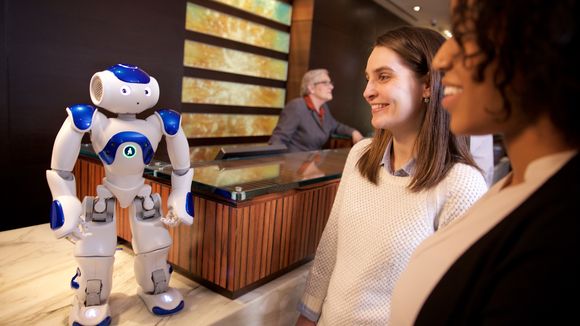
Connie (pictured above), a Watson-enabled robot concierge, has made its debut at the Hilton McLean. IBM has developed the robot, which draws on domain knowledge from Watson and WayBlazer to help hotel guests figure out what to visit, where to dine, and how to find anything at the property.  Other hotel companies have experimented with robot technology as well. Starwood Hotels and Resorts has a Botlr, which can deliver room service. And the Yotel in New York has a luggage-toting robot.

In fact, despite the assumption by many that robots will be mainly used for taking care of rote tasks, they may be more important for communications between people and computer systems or cloud applications. This leads to the development of AI messaging interfaces called  “chatbots” on connected devices.

Chatbots

Messaging “chatbots” are basically software that can conduct a human-like conversation and do simple jobs once reserved for people.  Facebook has started to introduce chatbots on the messenger platform that allows us to chat and transact business with 1-800-Flowers and a few other vendors.  At the recently concluded F8 conference, Facebook revealed how they are planning to expand the list of chatbots with AI.   WeChat provides similar services in China to pay for meals, order movie tickets and even send each other gifts. In the near future, users of Microsoft’s Skype and Canada’s Kik can expect to find newly automated assistants powered by AI offering information and services at a variety of businesses. 

f8-messenger-platform-970-80

Messaging bots can handle a wider range of tasks including mobile maintenance crew, mobile inspection, processing warranty claims, and providing concierge services across a variety of consumer businesses. In part, that’s because bots can recognize a variety of spoken or typed phrases, where apps force users to choose from options on a drop-down menu. Reaching a chatbot can be as simple as clicking a link in an online ad or scanning a QR code with a smartphone camera. 

As the big messaging players open up their technology to bots, businesses and brands will need a bot presence to fill this communication with their customer base. I believe this will lead to an overhaul of internal data and business processes in order to provide on-demand services to customers, employees, and others on any connected devices.

Impact of AI  is growing

In The Second Machine Age MIT’s Erik Brynjolfsson and Andrew McAfee reveal the forces driving the reinvention of our lives and our economy. As the full impact of digital and cognitive technologies is felt, we will realize immense bounty in the form of dazzling personal technology, advanced infrastructure, and near-boundless access to the cultural items that enrich our lives.

Digital and cognitive technologies are capable of helping everything and everyone. Companies will be forced to transform to adapt to this change.  Let’s look at Amy – the virtual AI assistant. Amy isn’t a real person, she’s not even an app, she’s a virtual AI assistant that you can cc into email chats. Let’s see how Amy can help. 

“Shall we grab a coffee next week, maybe one afternoon?” someone asks me in an email.

“Sounds good, Amy will sort out the details,” I reply, cc’ing Amy into the conversation.

From there Amy takes over, offering meeting times that work for me and making suggestions of where to meet, like my favorite coffee-house (Crema Coffee Express Bar in Cary, NC) or the nearest Starbucks.  But I don’t see any of that, because Amy has taken over, managing the back-and-forth to work out the details.  The conversation is clear, directed, Amy refuses to be derailed and talks with a clear conviction to lock-down a time and location that works for everyone.

Conclusion

Even if you have a fancy car, you still have to decide where to go.                     – John Giannandrea, VP Engineering, Google

The ultimate dream of many advance thinkers in AI  is to create machines that can think as well as people. But today human judgment and creativity remain indispensable.  However, the impact of AI or cognitive technology on business will grow significantly over the next three to five years. This I believe is due to two factors. First, the performance of AI has improved substantially in recent years, and we can expect continuing research efforts to extend this progress. Second, billions of dollars have been invested to commercialize these technologies. Many companies are working to modularize and package AI technologies for a range of business functions and industries, making them easier to acquire and easier to deploy.  Together, improvements in performance and commercialization are expanding the range of applications for AI technologies and will likely continue to do so over the next several years.

Why Big Data needs Small Data?

AAEAAQAAAAAAAAWcAAAAJDYyMDAwODQwLThkZDctNDY0ZS1iMzg2LTg0YzY0YTMzOTY4MQ

Martin Lindstrom has spent time with 2,000 families in more than 77 countries to get clues to how they live — resulting in the acquisition of what he likes to call Small Data. In his new book, Small Data: The Tiny Clues That Uncover Huge Trends, he argues that the Small Data explains the “why” behind what Big Data reveals.

Big Data is all about finding correlations, but Small Data is all about finding the causation, the reason why.                                 –Martin Lindstorm

In his book, he talks about how the corporate world has become completely blinded by Big Data.  He also talks about how companies which are completely reliant on Big Data actually have started to have a problem.  He cites the example of Walmart, irrespective of having the largest data-mining and big data operations in the word, they had to issue a second profit warning recently.  He gave another example of Lowes Foods, which is my home town favorite in NC and now one of the fastest growing in the region.  Lowes Foods is actually living with the consumer in the community to understand the Small Data. That means listening closely to the community needs by  embedding themselves into the community. They’re talking with everyday consumers and integrating themselves deeper. As a result, they now have completely turned around and is now one of the fastest growing in the region because they’re listening to the consumer and the Small Data.

Need for Small Data

In a traditional sense, I agree it is very hard to describe emotions using just data and numbers. I also agree that it is very important to listen to the consumer via. the Small Data.  It would be ideal to elicit Small Data by living in the communities or by deeply embedding into the communities, but we can’t ignore the practical challenges and resource limitations to replicate this nationally.

Small Data lives on the Cloud

Let’s also look at how we are communicating in today’s world.  Technology’s rampant popularization over the past decade in terms of social media has meant that texting, WhatsApp, Next Door, Facebook, Instagram, and Twitter have inevitably taken over as the most efficient ways of communicating with each other. One can make an argument that in today’s world Small Data actually lives in the form of tweets, images, videos, product reviews, surveys, community blogs, etc. somewhere on the cloud.

Understand Small Data with Cognitive Computing

Understanding Small Data in today’s world means understanding the verbal and non verbal communications that are taking place on the cloud.  I believe cognitive analytics can bridge the gap quite nicely.

Cognitive Analytics is creating a new partnership between people and computers that enhances, scales and accelerates human expertise.

Like humans, cognitive analytics understands individual behaviors and can engage with humans.  It also learns from us and improves over a period of time.  We use our cognitive capabilities to understand emotions and other human behaviors.  Likewise, cognitive analytics can sort through millions of tweets, images, speeches, product reviews and other customer generated data points to understand human behavior, emotions, personality traits,etc.  Image below outlines cognitive capabilities available on the IBM Watson Developer Cloud.  Google and Microsoft are offering similar capabilities as well.

Develop Big 5 Personality Traits from user generated content

IBM’s Watson Developer Cloud includes a Personality Insights API/tool, which leverages linguistic analytics to extract a spectrum of cognitive and social characteristics in the form of Big 5 personality traits from the text data someone generated through blogs, tweets, forum posts, and more. This kind of personality analysis helps to understand, connect to, and communicate with customers on a more personalized level.

Evolution of Cognitive technologies

Cognitive technologies have improved dramatically in recent years. From machine learning, natural language processing (NLP), speech recognition and tone analysis, it now can extract visual insights from a collection of customer images from Instagram or Facebook collections. Corporations can now leverage these visual cues (Small Data) to understand customer behavior and needs.

Big Data meets Small Data

When companies start to weave-in Small Data from cognitive analytics into insights from Big Data and predictive analytics, they can deliver an enriching and personalized experience for their customers.

In summary….

There is a huge desire for tactile interaction with people, but unfortunately the physical community as we know is dying.  As a result, the human interactions are moving into the cloud.  We also need to fly/dive deep into the cloud to understand deep consumer psychology (Small Data) by analyzing human interactions on the cloud.  This type of analysis is going to be the biggest asset for every company going forward.

Begin with an end in mind for your Big Data journey

AAEAAQAAAAAAAAjcAAAAJGQ1MGVhMjVlLTUwYjYtNGI4Ni05OGI4LTJkZDY3NjBhOWVjNA

There’s been plenty said about how the power of big data and analytics will drive efficiency and open up new avenues and business models for today’s organizations.  Many times when discussing the topic of big data, the focus is on the volume of the data, the structure of the data or the near real-time analysis requirements of the data.  It’s a daunting task to keep up with big data technology and its landscape as you can see here.

Taking small steps to Big Data

Challenge is drawing insights from big data and analytics rather than being overwhelmed by them.

We hear about a lot of buzzwords on big data, however, often times what is missed are the end goals of the big data and analytics challenge we are trying to tackle. I’m not advocating to ignore the big picture on big data technology or data sources, rather provide clarity on where and how to get started.

Any successful big data and analytics initiative needs to focus on how the data can impact a company’s top line, bottom line or both when it is conceived and constructed rather than focusing on how many petabytes of information is available and how advanced the big data environment or technology you have access to.

The best way to dive into big data is to start small. Not in terms of the amount of data, but rather of your focus. Pick one area where you can use extra insight and begin by targeting your efforts there. Companies would benefit by starting small with a use case or a business problem that would bring value to the business today. It is important to identify a use case that is not overly complex, but would deliver business value. This approach would allow organizations to mobilize leadership support and business “buy-in” incrementally while planning for a big “home run” in the big data journey.

Visioning Workshops

Conduct a visioning workshop to brainstorm a set of business use cases to explore the “art of the possible,” and identify and then prioritize business outcomes that big data & analytics can help achieve. Develop a value case and select a use case with a minimum complexity to get started on this journey.

Big Data and Analytics Innovation Cycle

Gartner’s bimodal IT approach, while perhaps not new, is especially relevant for the big data and analytics innovation cycle. It starts with taking an use case, developing a hypothesis and an analytics approach, followed by developing analytical models and experimenting the approach on the cloud.

Modern cloud big data and analytical platforms and services such as IBM Bluemix, Microsoft Azure and AWS offer big data and analytics capabilities that can be brought to bear on a problem in a matter of minutes.  Companies can start generating useful answers in just days when the innovation cycle is deployed on modern big data cloud platforms.

“Two guys in a Starbucks can have access to the same computing power as a Fortune 500 company.” – Jim Deters, Founder, Galvanize

Such approaches can sidestep the long lead times and high cost of standing up a large-scale big data environments and focus on quickly proving (or disproving) hunches and hypotheses relating to the big data.

Big data doesn’t have to be daunting. By focusing and starting small, you can take your first steps into big data, and begin taking advantage of its big insights.

Travel experience is about to get lot more personalized….

Travelers have grown accustomed to seeing significant improvements in their online shopping experience. Yet travel and hospitality industry has been slow in adapting this pattern. In recent years, we’re seeing this trend changing slowly. Industry experts predict that 2016 may prove to be a breakout year for travel and hospitality companies in terms of providing personalized customer experience across all channels.

Customers from a wide variety of sources create mountains of structured and unstructured data, and the number and variety of sources continue to increase.  Digitization of customer activities, aided by plethora of mobile apps, online channels and devices is generating a massive digital exhaust as well. The challenge is harnessing this data to derive actionable insights from the noise. It is highly impossible to analyze this data with out the application of Big Data and Analytics technologies.

The good news is Big Data and Analytics technologies are not only maturing, but also consumption and deployment patterns are getting lot easier with the innovation from cloud development platforms such as IBM’s Bluemix, Microsoft Azure, Salesfore App Cloud and others. This allows travel and hospitality companies to try and test big data and analytics use cases by developing quick agile solutions prototypes without making a dent in their CapEx wallet. It allows them to pilot the results in a targeted manner as well.

Travel and Hospitality organizations have started to adopt foundational analytics capabilities. Creating robust segmentation models to develop actionable clusters of customers is just the starting point. Behavior attribution models can certainly help to an extent for targeted marketing. However, Cognitive and Predictive analytics can play a significant role in isolating relevant signals from the noise to understand the likely behavior of the individual and to elevate the overall customer experience resulting in improved customer satisfaction and business metrics.

Evolution of Cognitive technologies

Cognitive technologies have improved dramatically in recent years. From machine learning, natural language processing (NLP) and speech recognition, it now can extract visual insights from a collection of customer images from Instagram or Facebook collections. Travel and hospitality companies can now leverage these visual cues to enrich the customer 360 profile by incorporating insights from individual’s image collections in the form of preferred travel destinations, interests, places and leisure activities.

Psycholinguistics analytics – another Cognitive technology can now shed light on individual’s preferences and personality traits by analyzing the psychology of language and other attributes from individual’s twitter feed. According to a study published in National Academy of Sciences journal, computer-based personality judgements are more accurate than those made by humans.  It further empowers travel and hospitality companies to personalize communications and connect with customers across all channels.

Mass customization is morphing into Mass personalization

Mass customization was originally associated with manufacturing consumer products tailored to the requirements of the individual and has evolved to include personalized marketing, customer service, and a host of service offerings for consumers.  Digitization of personal and business activities, enabled by apps and devices that track both active and passive actions, now generates a massive trail of digital exhaust in the form of big data.  Efforts to analyze this big data  will begin to yield more sophisticated personalized experience, which will turn into automated mass personalization for travel, hospitality and other consumer businesses.

In Summary

As travel and hospitality companies increasingly adopt advances in Big Data analytics technologies, as device sophistication evolves and improves, and as individuals increasingly utilize mobile apps and devices that generate ever more digitized personal information, the field of personalized analytics will evolve in turn. Industry experts predict that 2016 may prove to be a breakout year for this trend, as cognitive and predictive analytics becomes more widely adopted as a scalable, operational capability in travel and hospitality organizations. Personalized analytics is about to get a lot more personalized — and valuable for individuals and travel providers.